
Reflections from National ICT Week 2026
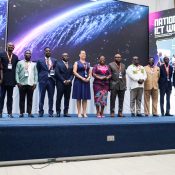
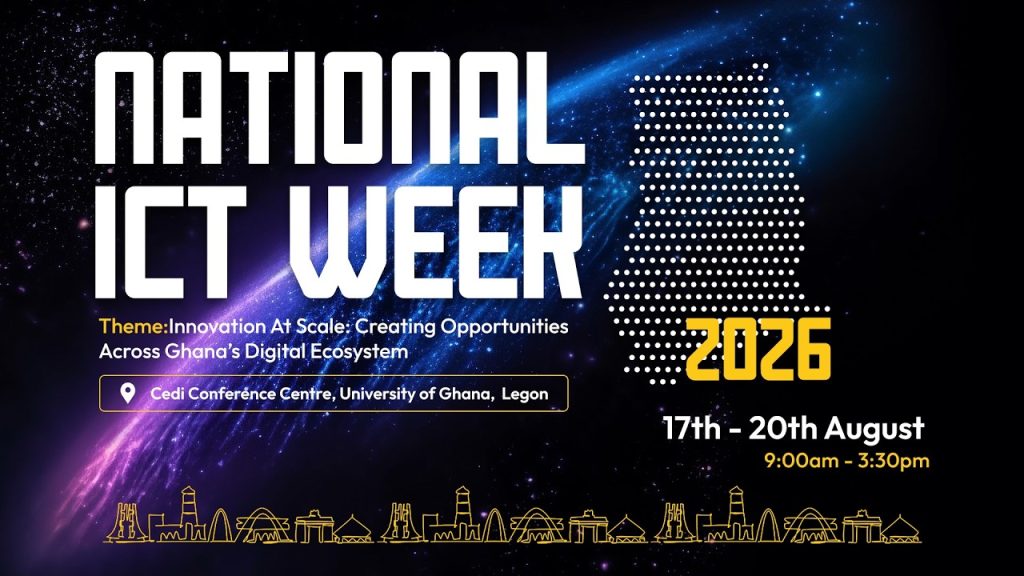
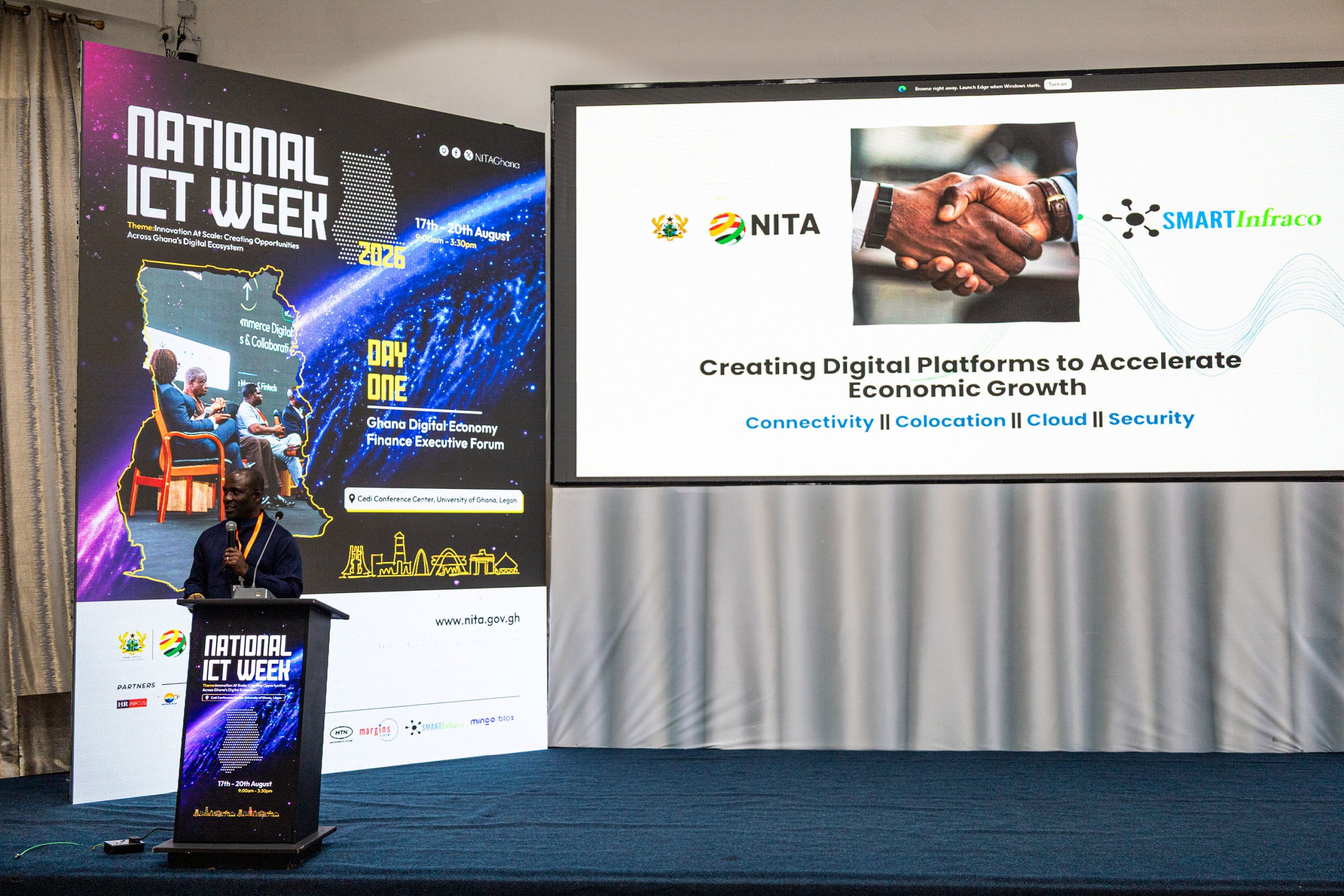
From August 17–20, 2026, the Cedi Conference Centre at the University of Ghana, Legon, brought together policymakers, technology leaders, innovators, development partners and businesses for the National ICT Week 2026, hosted by the National Information Technology Agency (NITA).
Held under the theme “Innovation at Scale:, Creating Opportunities Across Ghana’s Digital Ecosystem,” the four-day event explored what it will take for Ghana to move from digital ambition to meaningful, scalable impact.
For Smart Infraco, the conversation was particularly significant. As a sponsor of the event, we were proud to support a platform focused on the infrastructure, policies, skills and opportunities required to advance Ghana’s digital ecosystem. Our Chief Technology Officer, Michael Kwablah, contributed directly to the discussions as a panelist, bringing an infrastructure and technology perspective to the conversation.
One message emerged clearly: innovation at scale requires infrastructure at scale.
AI needs more than algorithms
Artificial intelligence is often discussed in terms of algorithms and applications. But behind every AI system is an infrastructure ecosystem, including connectivity, fibre, cloud platforms, computing capacity, data centres, devices and reliable power.
As AI adoption accelerates, Ghana must therefore think beyond access to AI tools. We must consider whether we have the infrastructure required to host, process, develop and scale AI locally.
This makes investment in fibre, cloud infrastructure, data centres and reliable energy increasingly important.
The discussions also highlighted the growing relevance of edge computing, which brings processing closer to where data is generated. For agriculture, healthcare, manufacturing and logistics, this can enable faster decisions while reducing dependence on distant computing infrastructure.
The future of connectivity is no longer simply about getting people online. It is about creating an ecosystem where devices, networks, computing infrastructure and data work together intelligently.
Building on what Ghana has already achieved
Ghana is not starting from zero!
The country has developed important digital foundations, including digital identity and payments, while continued investment in telecommunications and fibre is expanding the infrastructure required for new digital services.
The next challenge is interoperability.
Data that remains isolated within individual institutions cannot deliver its full potential. Secure data exchange, supported by appropriate legislation, standards and consent mechanisms, will be increasingly important as Ghana’s digital ecosystem matures.
This also brings data sovereignty into focus.
The question is not simply where data is stored, but who controls it, who builds products from it and who captures the economic value it creates.
Ghana has an opportunity to retain more of that value by strengthening local cloud and data infrastructure, cybersecurity, data governance and indigenous technology capabilities.
The goal is not to isolate Ghana from the global technology ecosystem, but to ensure that Ghana participates in it as a creator and owner of value.
Creating space for Ghanaian technology companies
Innovation at scale requires an environment in which local technology companies can grow.
A key challenge discussed was procurement. Emerging technology companies can struggle to compete for large public-sector opportunities because traditional requirements often favour businesses with substantial financial histories and established track records.
Yet many future solutions may come from precisely these smaller, innovative companies.
Creating pathways for startups and SMEs to enter the market, demonstrate their capabilities and scale is therefore critical to developing a sustainable indigenous technology industry.
The ambition should be bigger than supporting startups.
Ghana should be building technology companies capable of competing beyond Ghana.
People remain the critical infrastructure
No digital transformation can succeed without people capable of building and operating it.
Ghana needs engineers, cloud specialists, cybersecurity professionals, data scientists, AI practitioners, network specialists, developers and technology entrepreneurs.
But skills development must go beyond training and certificates. It must translate into practical skills, careers, opportunities and jobs.
Retention is equally important. Developing highly skilled professionals only to lose them to opportunities elsewhere limits the value of that investment.
A successful digital ecosystem must therefore create opportunities for talented people to build their careers and businesses here.
Making technology solve real problems
Perhaps the most important takeaway from National ICT Week was that technology should ultimately be measured by the problems it solves.
The conversation should move beyond simply discussing “AI” to AI for agriculture, AI for education, AI for healthcare, AI for energy and AI for logistics.
AI could help farmers identify crop diseases earlier, improve yields, support personalised education, improve energy forecasting and help businesses optimise supply chains.
This is where innovation becomes meaningful: when technology is designed around the realities and challenges of the people it is intended to serve.
At the same time, innovation must be accompanied by trust. Cybersecurity, data protection, digital forensics and responsible AI governance will become increasingly important as more of our economy moves into digital environments.
From ambition to execution
National ICT Week 2026 reinforced an important reality: Ghana has many of the foundations required to become a significant digital economy.
We have connectivity. We have digital public infrastructure. We have talent. We have technology companies, innovators and an increasingly sophisticated private sector.
The challenge now is connecting these strengths and moving decisively from ambition to execution.
Policies must translate into implementation. Infrastructure must work together. Procurement must create room for emerging innovators. Industry and academia must collaborate more closely. And the private sector must be empowered to play a central role in building what comes next.
For Smart Infraco, our participation in National ICT Week 2026, both as a sponsor and exhibitor, reflects our belief that the private sector has an important role to play in this journey.
We cannot simply observe Ghana’s digital transformation.
We must help build it!
The future of AI and digital innovation will depend on more than technology itself. It will depend on the networks that connect us, the computing infrastructure that powers us, the energy that sustains us, the data frameworks that govern us and the people who know how to put it all to work.
The opportunity now is to turn the ambition of “Innovation at Scale” into tangible progress, building the infrastructure and ecosystem that allow Ghanaian innovation to scale across Ghana, compete across Africa and ultimately reach the world.